Excellent Practices
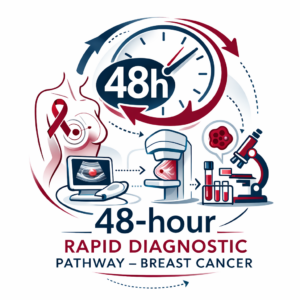
Diagnosis – Specific Examples of Innovation: The 48-hour Breast Cancer Diagnostic Pathway
Practice Category: Diagnosis
Centre: OncoZON Cancer Network
Esmee Volders
Policy Advisor
esmee.volders@mumc.nl
Challenge addressed by the practice
Before 2018, breast cancer patients in the OncoZON region experienced major variation in diagnostic waiting times, ranging from same-day clarification to delays of several weeks. This caused anxiety, uncertainty, and inequity between hospitals. Patient organisations, particularly the Dutch Breast Cancer Association (BVN), advocated for a maximum of 48 hours between referral and diagnostic clarification, but this was not structurally implemented. In addition, patients often felt insufficiently informed about what would happen during the diagnostic phase and when they would know whether their abnormality was benign or malignant. The combination of long waiting times, fragmented communication, and unequal access undermined patient-centred care and trust. OncoZON therefore identified the need for a network-wide, patient-centred and standardised rapid diagnostic pathway that would provide all patients with timely clarity about malignancy status.
Solution
In 2018, OncoZON implemented a network-wide 48-hour diagnostic pathway for breast cancer, ensuring that all patients quickly know whether their abnormality is benign or malignant. Core diagnostics (imaging, biopsy, and initial pathology) are completed within two working days, while additional tests (e.g., MRI or staging) may follow later. The breast cancer tumour working group harmonised the regional care pathway and aligned it with BVN standards.
A key design element addressed result communication: patients are offered the option to receive the first result by phone on the same day or next morning, followed by a face-to-face consultation within 1–2 days for detailed discussion and treatment planning. This approach proved highly valued by patients. Uniform patient information materials explain the process, timelines, and next steps. OncoZON coordinated implementation and continuous optimisation across all hospitals.
Impact
The 48-hour pathway has eliminated variation in diagnostic waiting times across the region and significantly improved the patient experience. Patients now receive rapid clarity on whether their abnormality is benign or malignant, even if additional diagnostics are still required to fully characterise the tumour or determine staging. This early certainty reduces anxiety and allows patients to mentally and practically prepare for the next steps. Patients know in advance what tests they will receive, when results will be available, and what possible outcomes mean for their treatment. Offering the option to receive the first diagnostic result by telephone has proven highly valuable, allowing patients to process the news in their own environment before the follow-up consultation. All patients, regardless of the hospital where they enter the network, receive the same diagnostic speed and the same information. The approach has strengthened multidisciplinary collaboration and increased trust in the regional breast cancer pathway.
Critical success factors
Key success factors included strong clinical leadership within the tumour working group, patient-driven standards from BVN, and OncoZON’s governance structure enabling alignment across hospitals. A shared and explicit definition of the 48-hour target—focused on providing clarity about benign versus malignant status—created realistic expectations for both professionals and patients. The development and use of uniform patient information materials ensured that all patients received consistent, understandable explanations of the diagnostic process and timelines. Close cooperation between radiology, pathology and clinical teams was essential to achieve the 48-hour target. A dedicated policy team coordinated implementation, monitored compliance and resolved bottlenecks. The shared commitment to equity, transparency, and patient-centred care motivated all institutions to adopt and sustain the pathway.
Next steps
OncoZON is further integrating the 48-hour pathway with digital patient information, real-time monitoring and broader breast cancer care pathways. The network aims to embed performance indicators that distinguish between time to malignancy clarification and time to full diagnostic completion. This model will be used as a blueprint for other tumour types and shared within OECI, including both the organisational framework and the patient-communication approach, to support adoption by other European cancer networks.