

Excellent Practices
From Play to Practice: How Games Can Support Skills Development in Paramedical Professionals
Practice Category: Treatment
Centre: Institut du cancer Paris CARPEM AP-HP.Centre Université Paris Cité

Valérie Quevreux
Oncological Nurse Manager
valerie.quevreux@aphp.fr
Challenge addressed by the practice
Several challenges led us to implement this annual training initiative for paramedical professionals.
- During our first OECI accreditation visit, experts identified an area for improvement related to paramedical training, which needed to be better encouraged and structured.
- The Paris CARPEM Cancer Institute was also facing a shortage of paramedical professionals following the COVID-19 pandemic. Releasing staff to attend training sessions was difficult due to limited workforce availability.
- In addition, new generations of professionals have different expectations regarding training: they want to learn while being actively involved. Training modalities therefore need to adapt to these new aspirations.
- Finally, another major challenge was to promote a transversal culture of patient safety across professional categories and to strengthen cohesion and the sense of belonging within a multi-site cancer institute.
Solution
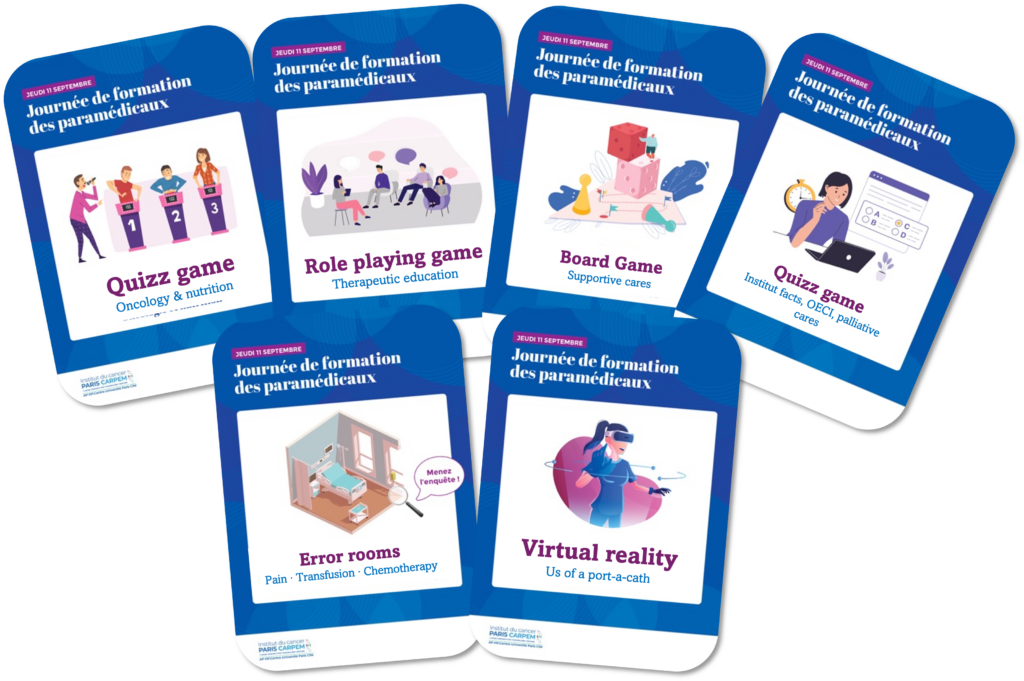
Institut du cancer Paris CARPEM designed an annual, multimodal, and playful training program dedicated to paramedical professionals, including nurses and radiology technologists. Developed in line with OECI recommendations, this training combines innovative educational formats such as simulation using virtual reality, “error room” scenarios, role-playing, a board game, and interactive quizzes.
The themes addressed in these workshops focus on the entire patient pathway, from initial care to palliative care. In addition, adverse events reported during the previous year were used to prioritise the topics addressed in the error room scenarios.
These workshops (scenarios and games) are made available to nurse managers so they can be easily deployed directly within clinical units throughout the year.
Impact
This training brought together 60 healthcare professionals from all departments and all sites of the institute.
A before-and-after knowledge assessment and a satisfaction survey were conducted.
Knowledge levels increased by 30% by the end of the day, and overall participant satisfaction reached 87%, with an average score of 4.5/5.
Key strengths identified included the clinical relevance of the workshops, improved cohesion between different professional categories, better understanding of each profession, and the playful and immersive nature of the training.
Areas for improvement included extending the duration of post-workshop debriefings, adjusting the dynamics of certain games, and addressing difficulties some participants experienced when using the virtual reality headset.
The organisation of this initiative mobilised management teams, functional departments, and medical teams. Their feedback was also very positive regarding the topics covered, the co-creation of tools, and the organisation and facilitation of the workshops.
Critical success factors
Several factors were decisive in the success of this initiative.
First, the co-construction of the program with a wide range of stakeholders—including physicians, paramedical professionals, and functional departments—helped engage the entire community and ensured that the training was aligned with clinical realities.
Second, the use of playful and innovative learning methods increased participant engagement and satisfaction. Games proved to be an effective tool for improving knowledge and updating skills.
In addition, before all workshops, organisers emphasised that participants were free to make mistakes without consequences or judgment. This reminder fostered a climate of trust and reduced stress during the training.
Finally, participants worked in small groups during the workshops, allowing active participation, frequent exchanges, and close interaction with trainers.
Next steps
This training initiative is now sustainable and will be repeated annually.
Adjustments will be made based on feedback from participants and organisers to further improve the program.
The scope of the institute was recently expanded to include pediatric oncology.
The training program reflects this change, with pediatric oncology specifically integrated into the error room scenarios.