

Excellent Practices
Governance
Practice Category: Governance – Structure
Centre: Leuven Cancer Institute
Evy Lobbestael
Institute Manager
evy.lobbestael@kuleuven.be
Challenge addressed by the practice
As a comprehensive cancer center embedded within both KU Leuven and University Hospitals Leuven (UZ Leuven), LKI operates in a complex institutional environment.
- A central challenge is developing a governance model that aligns closely with the strategic priorities of its parent institutions, while at the same time fostering engagement, shared accountability, and clear communication across a diverse member community.
- Additional challenges include avoiding fragmentation and siloed activities across departments and services, coordinating cross-cutting oncology activities in research, care, and education, and ensuring transparent, consensus-based decision-making.
- Balancing strategic oversight with operational efficiency, while safeguarding responsiveness to emerging opportunities and challenges in oncology, requires continuous coordination, evaluation, and alignment across multiple governance and operational layers within a broader university and university hospital setting.
Solution
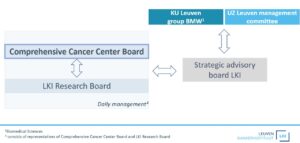
To address these challenges, LKI has implemented a multi-layered governance structure:
- At its core is the Comprehensive Cancer Center Board (CCCB), comprising hospital leadership, KU Leuven representatives, thematic coordinators, domain experts, and a dedicated management support team. This board is responsible for developing, approving, and implementing the overall LKI strategy.
- A Strategic advisory board ensures high-level alignment with KU Leuven, UZ Leuven, and VIB-CCB (part of the Flemish Institute for Biotechnology) strategies.
- Research priorities are defined within the LKI Research board, which integrates university policy mandates, focus group leaders, central platform representatives and innovation managers.
- Daily operations and coordination are ensured by the Daily Management, enabling coherent implementation across research, care, and education.
Clear terms of reference, consensus-based decision-making, structured reporting, and transparent communication underpin all boards.
Impact
This governance model has strengthened the visibility and integration of LKI within the University Hospital (currently 26 oncological care programmes) and KU Leuven structures. It supports coherent strategic planning across the full spectrum of LKI activities, underpinned by a robust planning-and-control cycle.
Enhanced cross-departmental integration has reinforced collaboration, enabling LKI to collectively anticipate and respond to scientific, clinical, and societal challenges, while reducing siloed activities across departments and services. The close connection between the cancer center and the university further strengthens alignment between clinical practice, research, and education, with many clinicians actively contributing.
Critical success factors
- Strong institutional embedding: high-level engagement from hospital and university leadership ensures strategic alignment and institutional support.
- Clear governance roles: clearly defined terms of reference, transparent reporting, and regular communication foster trust, accountability, and shared ownership. The presence of a dedicated management structure ensures continuity, coordination of daily operations, and effective implemen-tation of strategic objectives across our institute.
- Clear responsibilities: a deliberate focus on department-transcending activities prevents siloed (competitive) initiatives and maximises the use of available expertise without interfering with topic-specific activities and visions.
- Consensus-based decision-making to strengthen mutual trust, promote collective ownership of decisions, and support well-balanced outcomes that are broadly supported across disciplines and organisational levels.
Next steps
LKI aims to further strengthen engagement and ownership among board members and broaden communication, interaction, and involvement across its membership. The board structure will be modestly expanded, with an increased emphasis on domain/expertise-based rather than department-based representation to reinforce cross-cutting perspectives. Community-building, facilitation, and broader internal communication stays a priority to get a thriving institute.