Excellent Practices
Governance
Practice Category: Governance – Structure
Centre: Catalan Institute of Oncology
Tarsila Ferro
Director of Strategy and Quality Management
tferro@iconcologia.net
Challenge addressed by the practice
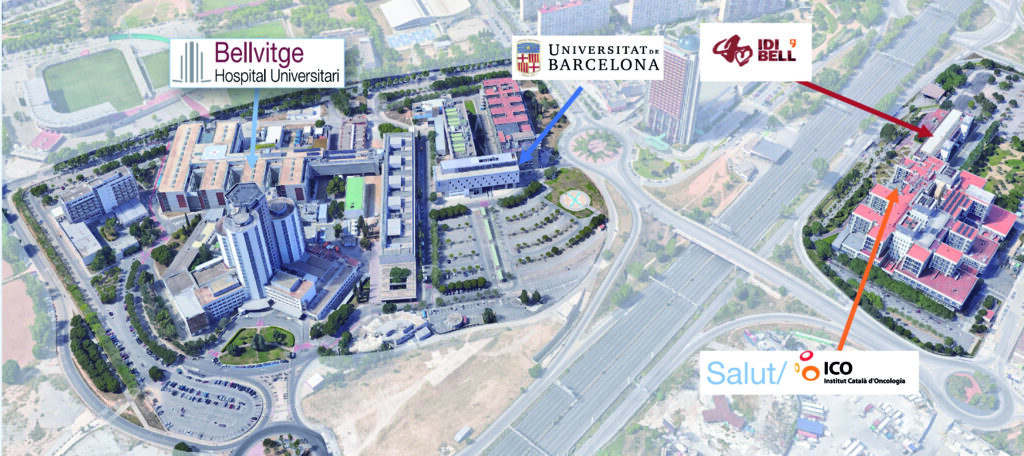
The CCC ICO–HUB comprises two hospitals. On the one hand, the Catalan Institute of Oncology (ICO) is a cancer center that offers all types of oncological services and treatments. On the other hand, Bellvitge University Hospital is a highly complex general hospital that provides diagnostic and surgical procedures in oncological care. Together, they are responsible for providing cancer care to an adult population of 1.7 million, working in coordinated multidisciplinary teams for more than 30 years. As two different public institutions, they also work with the Research Institute and the University of Barcelona on the same campus, making it a challenge to establish joint governance as a comprehensive cancer center.
Solution
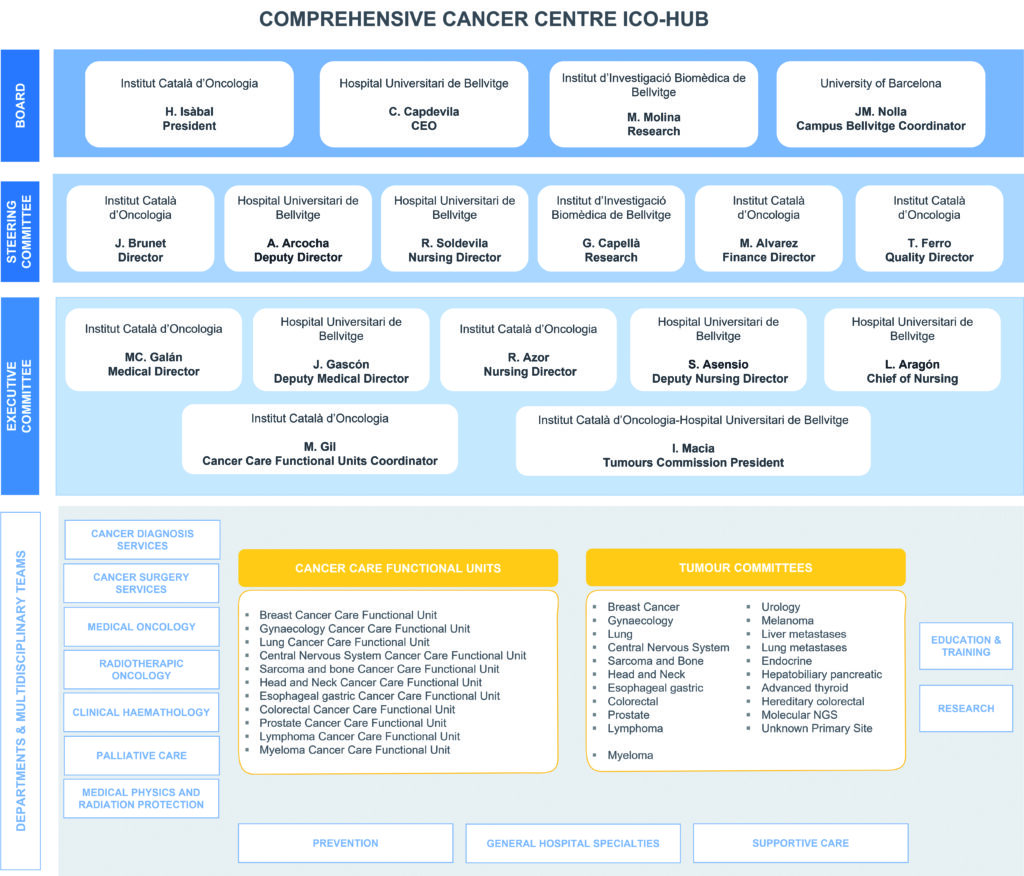
Joint governance was established with representation from the Campus entities with specific roles for the governance of the comprehensive cancer centre and avoiding duplication. Three levels of governance were established:
- Board: With representation from CEOs of each of the institutions ICO–HUB, IDIBELL (research institute), and the University of Barcelona. It meets annually with the CCC director to analyse progress and approve the strategic plan.
- Steering Committee: This body is responsible for the CCC’s strategy elaboration and guarantee its implementation. It meets at least three times a year to approve the proposals of the Executive Committee, especially those related to the budget or organisational measures with a significant impact. It is led by the CCC’s Director. The rest of members are directors, representatives of care, research, quality management, and finance.
- Executive Committee: Its members are medical and nursing representatives. They meet monthly to set annual objectives for the multidisciplinary teams involved in clinical care, research, and training. The body manages the oncology activity, the multidisciplinary care teams, and all the services involved.
Impact
This type of governance has made it possible to:
- Establish an optimal multidisciplinary oncology organisation, with a unique oncology process
- Operationalise the strategy in harmony with the respective strategies of each centre
- Promote joint decision-making rather than decision-making by services or institutions, especially those related to economic costs
- Contribute to strengthening the internal culture of organised multidisciplinarity (top-down; bottom-up)
Critical success factors
The following key points have been identified:
- Definition of a framework document on the oncology process at the Campus. This sets out how to organise multidisciplinary oncology care and the professional roles involved.
- Formal agreement on oncology organisation on the Campus, specifying the different institutional contributions to the oncology process, as well as financial transactions, in the context of public companies belonging to the Catalan Department of Health.
- Agree on a governance structure that contributes to and supports the organisation of oncology care. Explicit designation of the functions of each level of governance.
Next steps
- Given that the ICO has a network of regional hospitals, it is planned to incorporate this reality into the current governance.
- Create a Patient Council with stable representation on the Steering Committee.