

Excellent Practices
Implementation of a Value-Based Model through Integrated Knowledge Areas and Clinical Quality Management to Enhance Person-Centred Care and Clinical Outcomes
Practice Category: Organisation and Quality Systems
Centre: Vall d’Hebron Barcelona Hospital Campus
Accreditation and Strategic Support Unit
acreditaciohuvh1@vallhebron.cat

Challenge addressed by the practice
The healthcare environment faces rising costs, aging populations, and fragmented care. Key challenges include reducing clinical variability, and safety incidents while adapting professional profiles to meet new patient demands for shared decision-making. Vall d’Hebron Barcelona Hospital Campus is one of Spain’s largest and most complex healthcare ecosystems, with over 11,000 professionals, 1,211 beds, and 2,200 clinical trials.
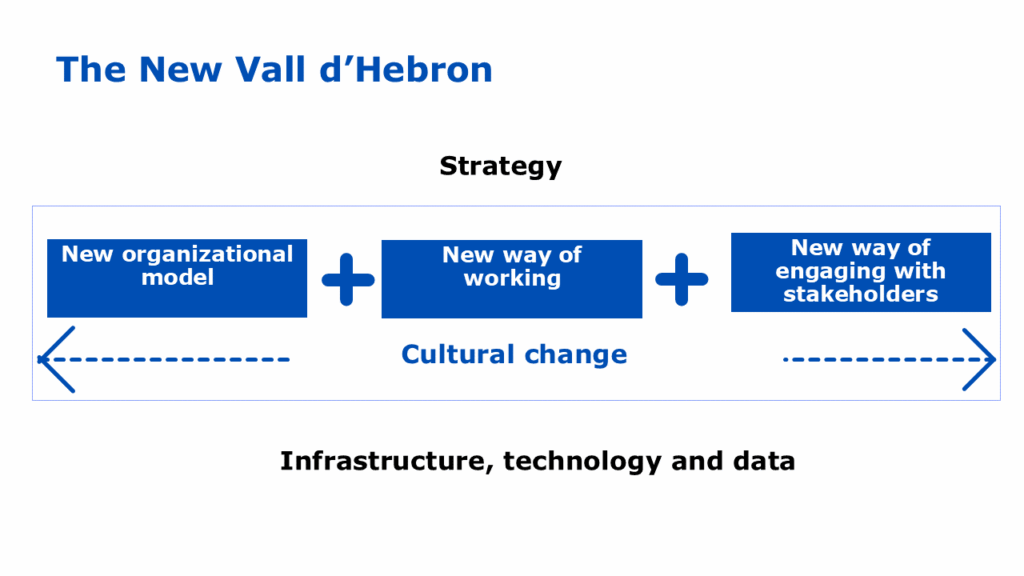
Ensuring high-quality, safe, and coordinated care required addressing fragmented clinical pathways and process variability. Consequently, the hospital launched “The New Vall d’Hebron” strategy, aligned with the Strategic Plan, supported by a transversal foundation of modern infrastructure, technology, and data.
This base enables cultural change through three pillars: a new organisational model based on integrated knowledge areas, a new way of working focused on clinical leadership, shared accountability, and continuous improvement, and a new stakeholder engagement approach. These changes aim to strengthen continuity of care and improve clinical outcomes, patient experience, and efficiency.
Solution
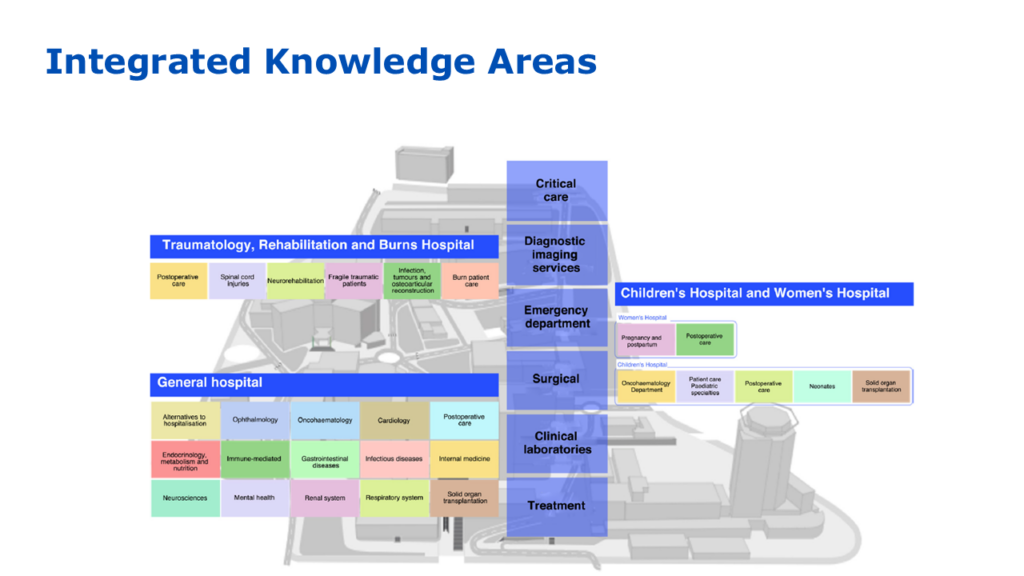
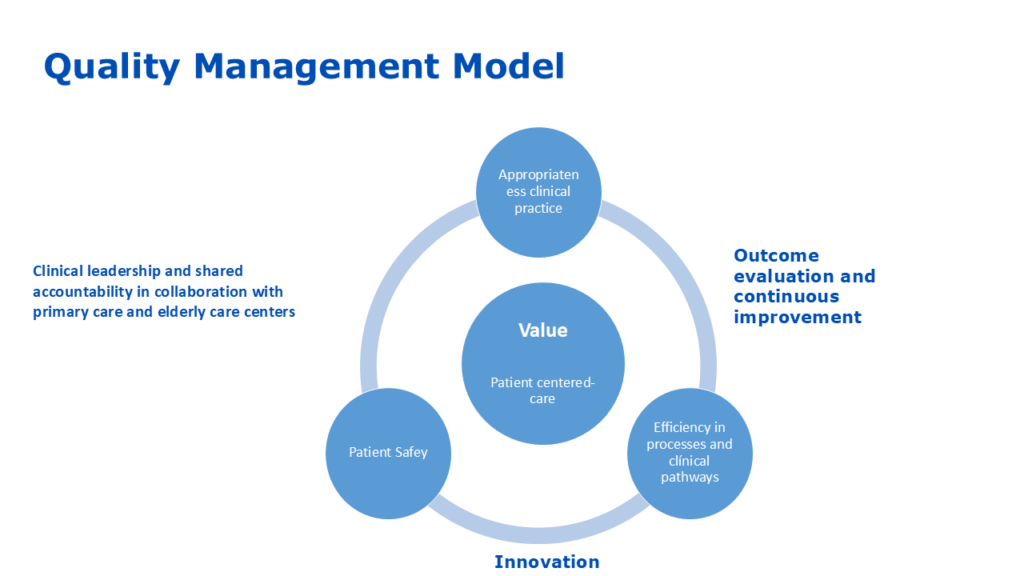
Vall d’Hebron implemented a comprehensive approach combining a robust Quality Management System (QMS) with a new integrated organisational and care model to drive cultural change. The QMS supports continuous improvement and risk management through eight strategic lines in the Quality and Safety Plan. The Quality, Processes, and Innovation Department supports the hospital’s strategy by integrating process improvement, patient safety, appropriateness, healthcare innovation, and accreditation into a unified framework. These pillars are monitored through cancer-specific dashboards tracking adverse events and clinical outcomes. The new organisational model is structured into 35 integrated knowledge areas to reduce fragmentation, enhance teamwork, and deliver person-centred care using the ATIC classification system to adapt care intensity in hospitalisation.
A Clinical Management Model fosters value-based care through leadership, shared accountability, and continuous improvement. Finally, the ICE Model (Information, Co-creation, and Strategy) ensures structured participation of patients and families, enabling shared decision-making.
Impact
The implementation of the integrated organisational and quality system has resulted in measurable improvements:
- Quality and Safety: Continuous monitoring and risk management have reduced adverse events and improved patient safety.
- Patient Experience: More personalised, agile, and responsive care with better continuity across transitions; cancer-specific dashboards allow targeted interventions.
- Clinical Outcomes: Improved health outcomes through better adjustment of nursing care intensity, reduced fragmentation, and increased efficiency via stronger multidisciplinary integration.
- Professional Development: Clear responsibilities, emergence of new roles, reinforced leadership, and enhanced teamwork.
- Replicable Model: Provides a benchmark for other OECI-designated Cancer Centres seeking integrated, person-centred, and outcome-oriented care delivery.
This approach has strengthened continuity of care, improved clinical outcomes, and enhanced patient experience, while fostering cultural change and collaboration across professionals, patients, and institutions.
Critical success factors
Success was driven by a combination of organisational, cultural, and technological enablers.
Strong clinical and executive leadership, permanent structured organisational communication, and clear governance ensured alignment of quality initiatives with organisational priorities and facilitated decision-making.
A fully staffed Quality, Processes, and Innovation Department provided the structure to coordinate patient safety, accreditation, and continuous improvement hospital-wide.
Interdisciplinary collaboration within Integrated Knowledge Areas reduced fragmentation, promoted teamwork, and reinforced shared accountability.
Active engagement of professionals, patients, and families fostered ownership and adherence to new workflows, embedding person-centred care principles.
Robust monitoring systems and cancer-specific dashboards enabled data-informed decisions and targeted interventions.
Finally, continuous quality improvement, risk management, and external accreditation cultivated a culture of innovation and trust, essential for sustaining change and scaling the integrated model across the healthcare ecosystem.
Next steps
- Technological advancement: Future developments will integrate personalised medicine, predictive analytics, AI-driven tools, and expanded cancer-specific dashboards to enhance early risk detection and optimise care pathways.
- Professional development: Continuous professional development and interdisciplinary training programs will reinforce shared accountability and innovation.
- Patient-centered strategy: Structured patient and family engagement will be strengthened through co-creation models to ensure care remains person-centred.
- Sustainability and scale: These steps aim to scale the integrated model across services, ensuring sustainability and measurable improvements in quality, safety, and patient experience.