Excellent Practices
Multidisciplinarity – Network Multidisciplinarity Teams
Practice Category: Multidisciplinarity
Centre: OncoZON Cancer Network
Grard Nieuwenhuijzen and Esmee Volders
GI & Oncological Surgeon and Policy Advisor OncoZON
danielle.holthuijsen@mumc.nl or esmee.volders@mumc.nl
Challenge addressed by the practice
Significant regional variation existed in the management of oesophageal and gastric cancer patients, including large differences in the likelihood of receiving curative treatment (54–83% for oesophageal cancer and 37–100% for gastric cancer) and associated survival differences between hospitals. Evidence showed that patients were not consistently discussed with an expert centre, resulting in unequal access to optimal treatment strategies and clinical trials. This undermined the principle of “equal care for equal patients” across the network. Referral pathways were fragmented, multidisciplinary expertise was unevenly applied, and decision-making quality depended heavily on local hospital capacity and experience. These disparities were further exacerbated for older patients, those with comorbidities, or those presenting with metastatic disease, who were less likely to be discussed in expert settings. The challenge was therefore to reduce unwarranted variation, ensure equitable access to expert advice, and standardise high-quality multidisciplinary decision-making.
Solution
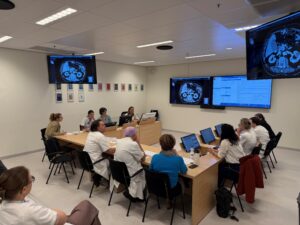
The Brainport Upper GI Network within OncoZON implemented a regional, online MDT for all patients with oesophageal and gastric cancer. Instead of referring all patients to an expert centre, all cases are discussed jointly with the expert centre in a weekly regional video MDT. A harmonised regional care pathway and service-level agreements were established, defining what care can be delivered locally and what requires centralised expertise. Case submission was made low-threshold and efficient: referring hospitals submit a minimal dataset, coordinated by dedicated case managers, with second-opinion radiology and centralised preparation. The MDT includes all relevant disciplines (surgery, oncology, radiotherapy, gastroenterology, radiology, nuclear medicine, pathology, and nursing specialists) and results in a single, shared treatment plan covering what, where, when, and how. Clinical trials are always taken into consideration. Gradual implementation across hospitals took place between 2014 and 2017, supported by digital infrastructure and quality monitoring.
Impact
After implementation, the proportion of patients discussed in an expert setting increased substantially, and variation between hospitals in access to multidisciplinary expertise disappeared. The likelihood of receiving curative treatment became more uniform across the region. Data analyses demonstrated improved consistency of care, more appropriate treatment allocation, and increased inclusion in clinical trials. Importantly, survival outcomes improved, both for the total patient population and for patients treated with curative intent. Hospitals reported higher satisfaction and engagement, and collaboration between centres intensified. The MDT advice matched the treatment actually delivered in 97% of cases, indicating high-quality and actionable decision-making. Patients benefited from more equitable access to expertise, reduced unwarranted variation in care, and a higher probability of receiving guideline-concordant, personalised treatment. Overall, the regional MDT contributed to better clinical outcomes, improved quality of care, and strengthened network-wide cooperation.
Critical success factors
Key success factors included strong clinical leadership from the tumour working group, formal regional agreements on care pathways and roles, and full multidisciplinary participation. Low-threshold referral procedures and minimal administrative burden for referring hospitals were essential for uptake. Dedicated case managers ensured coordination, data completeness, and continuity. Centralised second-opinion radiology and structured MDO preparation improved decision quality. Clear scheduling, strict time management, and rotating chairmanship supported efficient meetings. Digital infrastructure enabled secure data exchange and high-quality video conferencing. Continuous quality monitoring using regional indicators and national cancer registry data (IKNL) provided feedback and supported iterative improvement. Regular network meetings fostered trust, shared ownership, and alignment across institutions. Importantly, the explicit commitment to “equal access to the best treatment” created a shared vision that motivated sustained participation and long-term embedding of the MDT within routine clinical practice.
Next steps
Next steps include extending the regional MDO model to additional tumour types within OncoZON, further standardising digital data exchange, and integrating structured decision-support tools. The network aims to enhance patient-reported outcome monitoring, strengthen links with clinical research infrastructure, and further reduce residual variation in care for vulnerable subgroups. International benchmarking and knowledge exchange, including through OECI, will be used to refine the model and support broader European implementation.